THE QUICK TAKE
- Follow the routine from approach to a place for belongings.
- Give deliveries and visitor shoes a location outside the route.
- Record doorway repairs separately from family housekeeping tasks.

Ask about the moments that make arrivals difficult
Choose a recent, ordinary trip as a conversation starter: coming back from shopping, a walk, or an appointment. Ask what they were carrying, where they put it, and whether someone helped. Do not ask them to recreate a difficult movement to show you the problem.
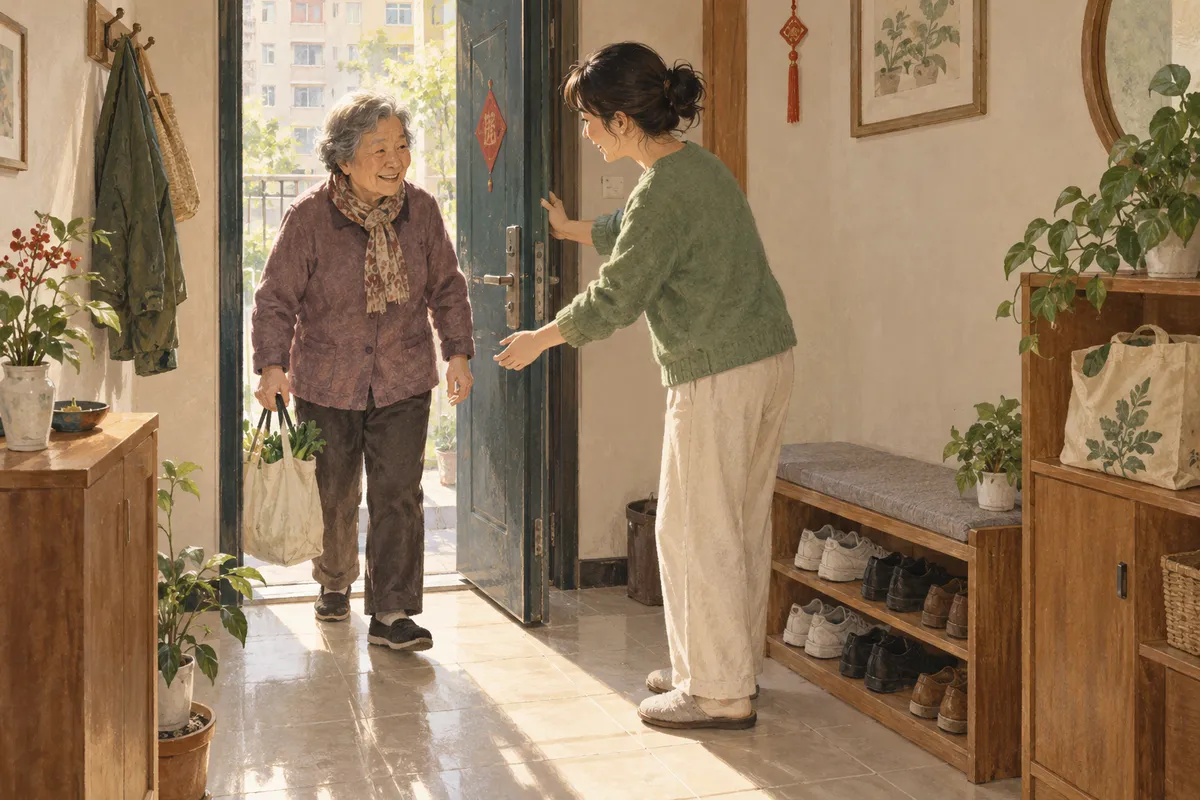
Map the route from the approach to the first room used inside. Include the door's movement, entry furniture, shoes, bags, and any entrance steps. A front door and a side door may have different problems. Use the route your parent prefers rather than assuming the most formal entrance is the useful one.
Ask about leaving as well as arriving. Where are keys and a phone kept? Who switches on a light for an evening return? Which tasks could a visiting helper handle? Record the household arrangement your parent wants, rather than presenting a list of changes as a finished decision.
Create an agreed place for bags, mail, and deliveries
An entrance needs a repeatable plan for things that arrive. Ask where your parent wants mail and small parcels put. Choose a location that does not interfere with the doorway or the next part of the route. Check that it remains usable when several deliveries arrive together.
Write clear instructions for family members who drop off groceries. For example, 'Please take the bags to the agreed kitchen spot rather than leaving them behind the front door.' This is an illustrative household instruction, not a universal carrying method for the person being cared for.
CDC's home checklist addresses objects that obstruct walking routes. Use that as a prompt to check what accumulates here between visits. Give visitor shoes, umbrellas, and reusable bags a home. If your parent wants furniture near the door, discuss its purpose before moving it, and keep any concerns about sitting or standing on the professional assessment list.
Record door, threshold, and step problems precisely
Look for visible damage, a door that catches, or a threshold your parent identifies as difficult. Photograph it only with permission. Describe what happens in ordinary use rather than declaring a feature safe because it looks small or familiar.
NIA's outdoor guidance includes checking entrance steps for broken or uneven surfaces. Arrange appropriate repairs instead of trying to hide a defect with a loose covering. If rails, a ramp, or another support may be needed, ask about a home assessment and use qualified help for planning and installation.
Keep a repair record with the exact entrance, issue, reporting date, and person contacted. 'The side-door step is damaged' is more useful than 'the porch is unsafe.' If a landlord manages the property, follow their reporting process. Do not close the task just because an email was sent; note the response and expected next step.
Check the entrance as it is used after dark
A daytime visit cannot show whether the exterior light reveals the doorway on an evening return. Inspect lighting yourself from a safe position, including how it is switched on. Avoid asking your parent to approach an unlit step as a test.
NIH identifies good lighting as a home fall-prevention measure. Translate that into specific household questions: does the person returning home know which control to use, and is there a plan for a failed light? If a fixture or wiring needs work, assign the job to an appropriately qualified professional.
Check the transition inside too. A well-lit porch can lead into a dark entrance crowded with belongings. Discuss whether an existing light can be left on or operated conveniently. Do not specify a single brightness or product as suitable for every parent; record the gap and review the real arrangement.
Plan departures with the people who help
Share the entrance plan with the people who visit or provide transport, with your parent's agreement. Keep it short: where to meet, where deliveries go, how to contact the household, and which entrance they prefer. Avoid adding personal health details that a visitor does not need.
Include the people who arrive on a schedule, such as a cleaner or grocery helper. Ask whether they know where belongings should go and how to leave the entrance afterward. A short note inside the household plan can prevent repeated confusion without disclosing private care information.
If returning home involves a difficult transfer or a mobility aid, ask the care team for individual guidance. A family checklist does not establish a safe assistance technique. Helpers should not improvise lifting or support simply because they are standing beside the door.
Schedule a review after the repair, a furniture change, or a change in routine. Ask whether your parent can find what they need and whether visitors follow the agreed plan. Entrance safety for older adults works best as a practical arrangement the household can maintain, with structural and care questions left open until appropriately resolved.
Separate delivery clutter from an entrance repair
Review the entrance as a sequence: approach, open the door, put down belongings, and continue inside. A clear doorway at noon does not explain where a parcel goes that evening. CDC addresses obstacles and damaged surfaces in its checklist; this entrance review adds family decisions about deliveries and follow-up.
Write the place and trigger. A package left in front of an inward-opening door gives a helper a specific problem to solve. A delivery message can address placement, while a sticking door needs a repair request. Do not ask your parent to demonstrate an uncomfortable movement to prove the issue. Discuss the arrangement together without turning the visit into a test.
Parcels block the doorway or landing
- Next action
- Agree on a delivery location and send specific instructions to regular helpers.
- Check before calling it done
- A parcel can be left there without obstructing the door or onward route.
Coats and bags accumulate by the entrance
- Next action
- Give regularly used belongings an agreed storage spot.
- Check before calling it done
- The spot still works when visitors arrive, not only after tidying.
Door, latch or threshold appears damaged
- Next action
- Describe the fault for the responsible repair service; share photographs with permission.
- Check before calling it done
- The fault has been addressed; a message marked received is not a completed repair.
The route is hard to see after dark
- Next action
- Review lighting and refer fixture faults to an appropriate tradesperson.
- Check before calling it done
- The original evening visibility complaint is revisited after work.
Safety guidance: CDC: Check for Safety home checklist. Family examples and completion checks are editorial planning suggestions.
Write a parcel plan before the next delivery
Use this fill-in message as a household template: 'For deliveries to [entrance], our agreed parcel location is [place]. If that location cannot be used, please [agreed alternative]. Our household contact for a delivery question is [contact method].' Your parent should choose what information is shared. Do not put private access details or a door code in a public note.
Complete the receiving side too. Record who checks for a delivery, who can move a parcel that your parent does not want to handle, and where empty packaging goes. Ask each person to accept their task; naming an unavailable relative does not create coverage. If nobody is available, agree how a delivery will be rearranged or another willing helper contacted before ordering a bulky item.
After the next parcel arrives, compare what happened with the plan. Did the courier use the agreed place? Did the household helper know the item had arrived? Was the packaging removed from the entrance? Record the problem as a process change, such as updating an unclear delivery instruction, rather than assuming your parent should manage it alone. Keep the note about parcels only.
It should not become permission for a visitor to enter the home or handle unrelated belongings.
Parcel destination
- Agreed detail
- Place: ___
Household receiving task
- Agreed detail
- Name: ___; contact: ___
Packaging afterward
- Agreed detail
- Person: ___; storage: ___
Fill in the template, then copy it to your own document. Edits stay on this page only and are lost when you reload or leave. Avoid private health details.
Common questions
Should every entrance have the same setup?
Review the entrances your parent actually uses. Door movement, steps, lighting, and storage can differ. Record each issue by location so a repair or household change does not get confused with another doorway.
Is a grab bar beside the door a simple DIY fix?
Seek individual advice about support needs and qualified installation. This guide does not establish placement, mounting, or suitability. Do not improvise a support fixture or use decorative hardware for that purpose.
What can a family helper do before a repair is complete?
Keep agreed routes clear, follow the delivery plan, and check the repair's progress. Discuss interim access with the property manager or appropriate professional rather than assuming an unassessed alternative route is suitable.
Sources & further reading
These public resources inform the safety guidance in this article. The household planning examples are our editorial suggestions.
- CDC: Check for Safety home checklist
Home-hazard checklist covering floors, stairs, kitchens, bathrooms, and bedrooms.
- NIA: Preventing falls at home, room by room
- CDC STEADI — patient and caregiver resources
Official brochures for older adults and family caregivers; includes downloadable home-safety material.
Educational guidance, not a clinical assessment or personalized medical advice. This article has not been individually reviewed by a licensed clinician. Read our editorial policy.